
5kW / 8kW / 10kW Hybrid Inverter Buying Guide: The Ultimate Comparison
What is a Hybrid Inverter? (And Why You Need One)
Before diving into sizing, we must clarify what you are buying. A Hybrid Inverter is the “Intelligent Brain” of your system. Unlike a standard grid-tie inverter that only works when the grid is on, a Hybrid Inverter manages the flow of power between Solar, Grid, and Batteries.
The 3 Intelligent Working Modes
The real value of a hybrid inverter lies in its software. A good inverter, like IHT’s models, offers three distinct modes:
- Self-Consumption Mode (Default): The inverter prioritizes your home loads first. If you generate 5kW of solar but only use 2kW, it sends the remaining 3kW to the battery. Only when the battery is full does it export to the grid.
- Peak Shaving Mode (Time-of-Use): You can program the inverter to charge the battery at night (when electricity is cheap) and discharge it during peak evening hours (when rates are high). This is pure arbitrage profit.
- UPS / Back-Up Mode: When the grid fails, the inverter automatically detects the outage and switches to battery power in less than 10 milliseconds, ensuring computers and servers don’t crash.
Crucial Distinction: The “Brain” vs. The “Tank”
A common misconception is that a Hybrid Inverter comes with a battery inside. It does not.
- The Hybrid Inverter: Is the power electronics device (the brain).
- The Battery: Is a separate component (the fuel tank) that you must connect to the inverter.
Note: This modular design is good! It allows you to pair an IHT Inverter with any capacity of IHT Batteries (5kWh to 50kWh) to suit your budget.
The Spec Sheet Decoder: 3 Core Parameters
Don’t just look at the “10kW” sticker. To ensure the inverter works with your solar panels and batteries, you must verify these specifications.
1. PV Input: Start-up Voltage & Oversizing
Oversizing: You will often see a 10kW inverter allowing 15kW of PV Input. This is highly recommended because it ensures your system generates enough power to cover home loads AND charge batteries even on cloudy days.
Start-up Voltage: Look for a low start-up voltage (e.g., 120V). Some cheap inverters need 200V+ to wake up, meaning they miss out on valuable early morning sunlight generation.
2. Battery Interface: The “Voltage Trap”
This is the #1 mistake beginners make. Hybrid inverters are not universal; they are built for specific battery voltages.
- Low Voltage (LV / 48V): The standard for 3kW – 8kW systems. Safe, mature, and compatible with IHT Wall-Mount Batteries.
- High Voltage (HV): The standard for 10kW+ three-phase systems. Requires specific IHT HV Stackable Batteries. DO NOT connect a 48V battery to an HV inverter.
3. EPS Output & Switching Time
Check the “Off-Grid Output” rating. Some cheap inverters are rated 5kW on-grid but only 2.5kW in backup mode. Ensure you get “Full Backup Capability”.
Also, verify the Switching Time is <10ms. If it’s >20ms, your WiFi router will reboot every time the power flickers.
Sizing Guide: 5kW, 8kW, or 10kW?
Choosing the right size isn’t about how big your house is; it’s about how you live. The inverter’s power rating (kW) limits how many appliances you can run simultaneously.
Option 1: The 5kW Inverter (The “Essentials” Choice)
Best For: Small households (1-3 people) or apartments.
Runs: Lights, WiFi, Fridge, TV, plus ONE high-power item (Microwave OR small AC).
The Limit: You have to manage your loads. You cannot cook dinner (Electric Stove) while running the AC and doing laundry at the same time.
Option 2: The 8kW Inverter (The “Family Standard”)
Best For: The typical modern family home (3-4 bedrooms).
Runs: All essentials + Central AC + Cooking (Induction) + Laundry running in the background.
The Limit: It handles daily life well, but will struggle if you add an EV charger into the mix while cooking dinner.
Option 3: The 10kW – 12kW Inverter (The “Power User”)
Best For: Large homes, Villas, or EV Owners.
Runs: Whole-house HVAC, EV Charger (7kW), Pool Pump, and everything else.
The Benefit: Zero compromise. You can live off-grid exactly as you do when the grid is on.
Quick Comparison: Load Capacity
| Appliance | Power Draw (Approx.) | 5kW Inverter | 8kW Inverter | 10kW Inverter |
|---|---|---|---|---|
| Lights + WiFi + Fridge | 0.5 kW | √ | √ | √ |
| + Inverter AC (Cooling) | + 2.0 kW | √(2.5kW Total) | √ | √ |
| + Electric Oven/Kettle | + 2.5 kW | !Limit Reached | √(5.0kW Total) | √ |
| + Water Heater | + 3.0 kW | ×Overload | !Limit Reached | √(8.0kW Total) |
| + EV Charger | + 7.0 kW | ×Overload | ×Overload | !Limit (Careful) |
The Market: Tier 1 vs. The Smart Choice
The solar inverter market is crowded. Understanding the tiers helps you decide if you are paying for performance or just a logo.
Tier 1 (Tesla/SMA): Premium brand recognition but often “Closed Systems” that force you to buy their expensive batteries.
Tier 2 (IHT Energy / Deye): The “Smart Choice.” These brands offer open compatibility (you can choose your battery) and excellent value. IHT’s Advantage: Unlike standard air-cooled inverters, IHT specializes in Liquid-Cooling ESS, bringing industrial-grade thermal management to residential systems for longer lifespans.
Battery Matching Guide
An inverter is only as good as its fuel tank. If you pair a Ferrari engine (10kW Inverter) with a lawnmower fuel line (undersized battery), you won’t get the performance you paid for.
The “Bottleneck” Effect (C-Rate)
Just because your inverter can pull 10kW, doesn’t mean your battery will let it. A single 5kWh battery often only allows a 2.5kW discharge. To unlock the full 10kW potential of your inverter, you typically need to parallel at least 4 units of 5kWh batteries.
| Inverter Size | Recommended Battery Pairing | Why this match? |
|---|---|---|
| 5kW | 10.24 kWh (2x IHT Wall Units) | Allows full 5kW discharge + overnight power. |
| 8kW | 15.36 kWh (3x IHT Wall Units) | Supports AC + Cooking evening peaks. |
| 10kW | 20.48 kWh (4x Units or HV Stack) | Unlocks full 10kW output potential. |
Visualizing the Connection (Wiring Diagrams)
(Disclaimer: Always hire a certified electrician. These are for educational planning only.)
Scenario A: The “New Install” (DC-Coupled)
This is the standard setup for most homes. Solar energy flows directly to the DC battery without being converted to AC first, making it highly efficient.
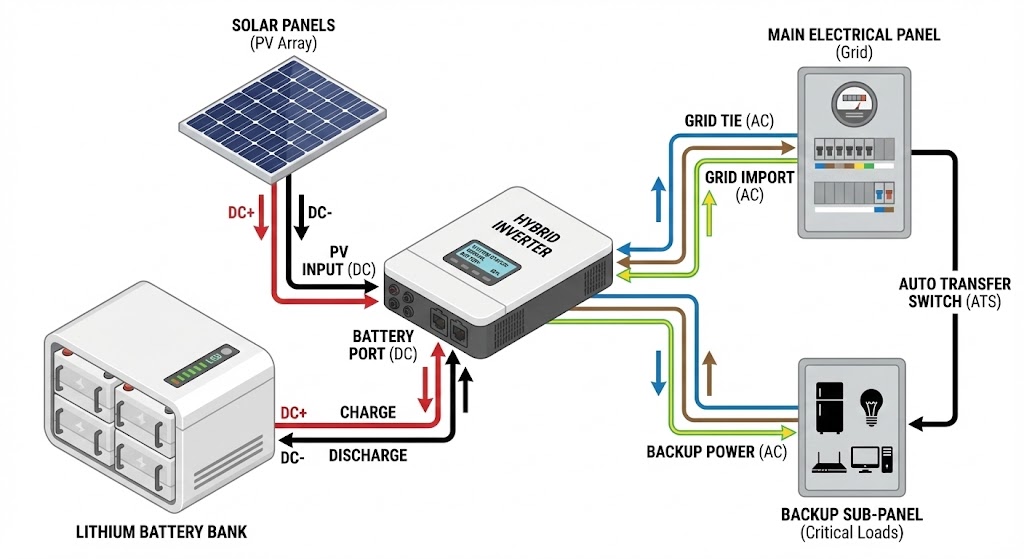
Figure 1: Solar panels connect to PV Input, Battery to Battery Input, and Grid to AC Input.
Scenario B: The “Retrofit” (AC-Coupled)
Already have an old solar system? No problem. In this setup, the new IHT Hybrid Inverter connects to your main AC panel. It “sees” the excess solar power on the line and uses it to charge the batteries.
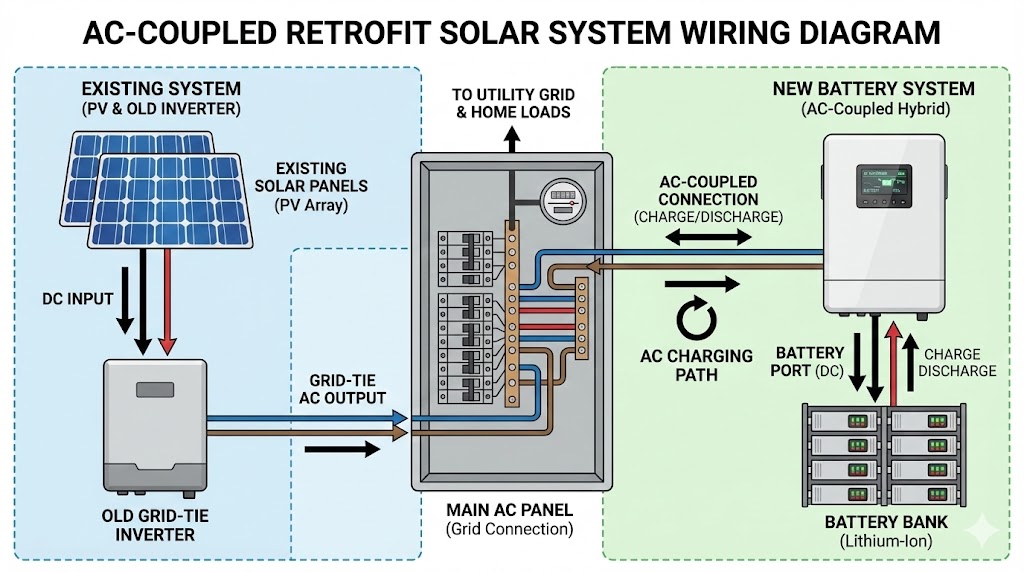
Figure 2: AC-Coupled Retrofit allows you to keep your old solar inverter.
Critical Install Tip: Split Your Loads!
Do not connect your entire house to the EPS (Backup) port. You must separate Critical Loads (Fridge, WiFi, Lights) from Non-Essential Loads (Pool Pump, Floor Heating). If you try to run the pool pump during a blackout, the inverter will overload and shut down.
Installation “Do’s and Don’ts”: Avoid Common Mistakes
A Hybrid Inverter is a high-voltage device. One wrong move can void your warranty. Here are the 3 Golden Rules for installers.
1. The “Start-Up Sequence” (Must Follow)
You cannot just flip switches randomly. The inverter needs a stable DC voltage to “boot up” its logic before dealing with high-voltage solar.
- Turn ON: Battery Breaker -> Inverter Switch -> PV Switch -> Grid Breaker.
- Shut Down: Grid OFF -> PV OFF -> Battery OFF.
2. Location & Airflow
Heat is the enemy. Even with 97% efficiency, a 10kW inverter generates heat. Install it at eye level with at least 30-50cm of clearance on all sides. Never install in direct sunlight.
3. CT Sensor Direction
The CT clamp tells the inverter if you are importing or exporting power. If installed backwards, your data will be upside down, and the battery won’t charge properly. Always ensure the arrow on the CT clamp points towards the Grid.
IHT Recommended Bundles
Ready to buy? Stop guessing and choose one of our engineer-approved packages.
The “Energy Freedom” Kit (Best Seller)
Inverter: IHT 8kW Hybrid
Battery: 15.36 kWh (3x IHT 5.12kWh Wall-Mount)
Performance: Runs AC + Cooking. ~15 Hours Backup.
Ideal For: Standard Family Home (3-5 people).
The “Ultimate Power” Kit (Premium)
Inverter: IHT 12kW Hybrid (3-Phase)
Battery: 20 kWh IHT High-Voltage Stack
Performance: Whole-home backup including EV Charging.
Ideal For: Large Villas & EV Owners.
Don’t Guess Your Energy Future
Every home is unique. Let our engineers design the perfect schematic for you.
Get Your Free System Design & Quote
Send us your electricity bill, and we will provide a custom wiring diagram and sizing report.
Post time: Dec-24-2025

